Showing posts with label fiction. Show all posts

May 3, 2011

Voices in My Head

Evan Fallenberg's When We Danced on Water, my favorite book so far in 2011—and my first Desert Isle Keeper in more than half a year, will be published later this month. It's terrific for a lot of reasons, chief among them its elegant prose.

Those of you who've known me online for long know that I often point out bad prose—hence a decade of the Purple Prose Parody Contest. It's less often that I talk about prose in a positive sense. When I do, it's generally to compliment spare prose, as I've done with other DIKs, such as Paulo Coelho's The Fifth Mountain, or overall spareness, both in prose and plot, as with Mary Balogh. Fallenberg's writing isn't so much spare as it is precise. Coelho's writing packs an emotional punch because the prose itself is so spare. Balogh's emotional success comes from the all-round spareness. It is Fallenberg's precision that works so well in this book because it allows him a tremendous fluidity, like Baryshnikov flying across a stage.

The book features an 85-year-old choreographer, so indulge my using that as a metaphor for Fallenberg's writing. Just as a choreographer can capture the fluidity and emotionality of a piece of music and dance, so does this author. Just as a dance features moments of different tempos and varies in boldness and strength, so does Fallenberg write with a pin-point focus, creating a similar fluidity and elegance.

In a couple of scenes his lead character explains how he sees and feels music in his head. While a beautiful concept, it did not fit my experience of music. I wanted needed to understand it better because it was conveyed with such beauty. As music is so integral to his being, I read those passages aloud to my husband, who seemed surprised when I asked if he understood what Fallenberg's character was trying to explain. "Of course," he said matter-of-factly, as though everybody experienced music in that way.

It's been quite awhile since we had that conversation, but it wasn't until recently that I realized he sees music...and when I'm reading, I hear dialog. I hear dialect, voice inflection, even timbre. I don't listen to audiobooks because hearing someone else voice characters interferes with my experience of hearing them in my head.

Among the reasons I so love Eve Dallas' Roarke is that his voice is so clear in my head, particularly when he jokes with Eve or croons sweet nothing to her in that yummy Irish brogue. And when he speaks Gaelic in moments of pure passion, I'm a goner. When a poster to yesterday's piece for H&H objected to a similar speech cadence in Roberts/Robb's writing, I had to sit back and think about whether I'd ever noticed that. I haven't, but I'll start paying attention. That said, though, some of her most vibrant characters are those with accents, so perhaps there's something to her criticism.

What about you? Do you experience music, art, or books in an unusual way?


Share/Bookmark

December 9, 2010

Life, Liberty, & the Pursuit of Sausages by Tom Holt

Life, Liberty, & the Pursuit of Sausages

Tom Holt

Grade: C+

When I saw the following snippet for Tom Holt's Life, Liberty, and the Pursuit of Sausages on NetGalley last month, I requested a copy for my Kindle:


Polly is a real estate solicitor. She is also losing her mind. Someone keeps drinking her coffee. And talking to her clients. And doing her job. And when she goes to the dry cleaner's to pick up her dress for the party, it's not there. Not the dress - the dry cleaner's.

And then there are the chickens who think they are people. Something strange is definitely going on - and it's going to take more than a magical ring to sort it out.

From one of the funniest voices in comic fiction today comes a hilarious tale of pigs and parallel worlds.


I read it over the weekend, and while at times I flashed to Norton Juster's The Phantom Tollbooth, Christopher Moore's Fluke, and the claymation movie Chicken Run - all of which allowed me as an adult to re-experience sheer child-like wonderment - at other times I got lost in a book that featured one too many sub-threads and one moment in the narrative for which there was no logical rationale. Even absurdist fiction, after all, follows a logic of its own, and because Holt otherwise adhered to his own warped premise so well, the one time he failed to do so stuck out like a sore thumb.

Because so many sub-threads make up Holt's book - and because it won't be released until February, 2011 - I don't feel comfortable revealing much about the plot. Polly, a lawyer, believes she must be losing her mind; somebody's drinking her coffee, taking care of items in her files, and then her dry cleaner disappears as though it never existed. She seeks advice from her jingle-creating brother, who deduces, using thoroughly modern means, that magic exists in the world after he wishes his upstairs neighbor away. He and his sister try to make sense of a world gone run more and more amok, discovering along the way an entire "underground" economy devoted to fixing this sort of craziness.

How it all relates to the sow who went out into the world determined to discover the fate of her twelve piglets is something that is revealed only after the introduction of a series of anomalies and strange characters. Because unlike Juster's classic this is a story for adults and not children, readers will need to stay on top of their game throughout the read. Even if they do, though, they may conclude that Holt spun out his story slightly too far, with one too many sub-threads, and with one plot point involving a phantom train that doesn't track back logically (no pun intended).

Holt deserves major kudos for his imagination and often lively story-telling, but I believe his cleverness got the best of him more than once. As a result, the sum of the book's strongest parts do not add up to as strong a whole, which disappointed me. I'm fairly certain others will enjoy Life, Liberty, & the Pursuit of Sausages more than I did, but I'd recommend Fluke (or any number of other Christopher Moore novels)...or The Phantom Tollbooth before recommending this one.

Life, Liberty, & the Pursuit of Sausages will be published in February; I read an advance copy provided by the publisher.


Share/Bookmark

May 13, 2010

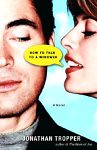
How to Talk to a Widower by Jonathan Tropper

How to Talk to a Widower

Jonathan Tropper

Grade: A-

Fiction

If asked for one word to describe Jonathan Tropper's How to Talk to a Widower, I'd choose one I don't throw around lightly: sublime. Devastatingly profane, laugh-out-loud funny, yet surprisingly emotional, it's a book I'm thankful that James at a bookstore lent to me after I heard about it from Laura, who had earlier been told about it by James.

Twenty-nine-year-old Doug Parker is slim and beautiful, and after Hailey, his wife of two years, died in a plane crash he is still so sad that he cannot move on in his life. The monthly column he writes about his inappropriate grief gained him a large magazine following, yet he refuses to follow his agent's advice and write a book out of his experiences that publishers are clamoring to buy. Instead he obsesses over the annoying squirrels who live in the garden of the house he shared with his wife, the house she previously shared with her first husband and their son Russ, now a grieving 15-year-old whose father Hailey realized was banging another woman when she found his snipped pubes in their bathroom trash can.

Women in the tony Westchester neighborhood want to take care of Doug - or sleep with him - while their husbands want to buy him lap dances. But he is forced out of himself by two things: Russ needs him to step up and be a father to him, and his bossy, pregnant twin sister Claire, who's decided to move in after leaving her husband, promises him that if he turns himself over to her, she'll fix him. God knows he needs the help...and can't rely on the rest of his family. His dad, once a prominent doctor, whom he can't remember as ever having hugged him, is becoming lost to dementia while his former actress mother, a cross between Marilyn Truman and Bobbi Adler from Will and Grace, self-medicates.

Meanwhile, his younger sister is about to marry a man she met and schtupped as he was sitting shiva for his dead wife, his twin begins arranging blind dates for him that invariably go badly, and if that weren't enough, he's falling for the temptation of his wife's [married] best friend's ample charms even though the feelings aroused by Russ' beautiful, quirky guidance counselor are anything but curricular. And so he tries to move beyond the anger, sadness, and self-pity overwhelming him, even though he's equally sad that one day, when he's moved on and has a happy new life and family, all he'll have of Hailey are minor memories.

Despite his being totally fucked up, Doug Parker is an appealing hero. Here's a guy who never believed he'd end up with a woman like Hailey, a guy who's smart - well, a smart-ass, anyway - funny, and a keen observer of human nature. He may think badly of other people, but he never believes worse about others than he thinks about himself...and how attractive is that? Though his relatives are not as fully rendered, all are well drawn, and a few scenes, involving either his father or his step-son, are stand-outs. While the story does veer toward the melodramatic near the end, all can be forgiven because two of those terrific scenes occur as a result.

Jonathan Tropper doesn't write absurdist fiction, but it's high praise indeed that How to Talk to a Widower reminds me in some ways of Christopher Moore's marvelous A Dirty Job. Both authors created hilarity from the dark premise of a beloved wife's death. Both authors appeal to those of us who are "wordies," readers who enjoy the use of language itself, but Moore's novel, while it does have moments of poignance, wasn't written to provoke the same feelings of tenderness Tropper achieves in his pathos-filled comedy. Inappropriate it may be, but brilliantly, funnily so. Thank you, James, for lending me your copy.


Share/Bookmark

May 4, 2010

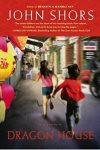
Dragon House by John Shors

Dragon House

John Shors

Grade: B-

Fiction

A couple of years ago I read and reviewed for Publishers Weekly John Shors' second book, Beside a Burning Sea. In my review I noted the beautiful prose, lyrical even when describing the horrors of war. His third release, Dragon House, presents more of a "I liked it, but..." quandary. Shors' writing remains captivating, but it's too earnest and sentimental. I wept as much while reading it as I do watching Terms of Endearment, but the book's heart-on-a-sleeve nature, which was likely behind the Kirkus reviewer's critique that "nonfiction might have better served the author's purpose," never fully faded into the background of the narrative. And, though I loved the young Vietnamese woman who is one of the story's lead characters, to be truthful she's one hell of a Mary Sue. Even with all these negatives, that the book had such an emotional impact on me cannot be denied. Add on top of that the questions it raised that I'd never considered, and my final grade is a B-, a recommendation, but one that comes with qualifications.

Iris Rhodes promised her father on his deathbed that she would continue his work in Vietnam and open a center for street children. Though his PTSD kept him in and out of her life for too long, she loved him and wanted to fulfill his dream. Along for the ride is Noah Woods, an embittered Iraq War vet who lost part of his leg - and his best friend - while serving overseas. He drinks to keep the pain at bay, and rages internally over the lies that led him to enlist. I happen to agree politically with that viewpoint and know there are many veterans who feel similarly, but I could never separate Noah's beliefs from those held by Shors. Perhaps it's because I read the book soon after attempting to read Lone Survivor, the memoir of Navy SEAL Marcus Luttrell, who tells of his harrowing experience in Afghanistan and being the only one of four SEALs to survive a mission. The first few pages of Luttrell's book are intensely emotional, but I stopped reading shortly thereafter as a result of his ultra right-wing views.

Thien is the young woman Iris' father hired to help create and run The Iris Rhodes Center for Street Children. Lovely, kind, full of lyrical stories about Vietnam and its dragon mythology, it's easy to see how she and Iris grew so close in such a short time, and that she and Noah were drawn to each other, he to the beauty she brought to every day life and her to the goodness she knew was locked inside him. As much as I loved Thien myself, even I found her to be the embodiment of a Mary Sue character. She reminds me of the idealized African-American women found in some of the Southern Fiction I love...a born nurturer, wise beyond her years, soothing, and always with a story or song to brighten a dark day.

Other characters are woven into the story as the three work to finish the Center: a devoted grandmother trying to care for her young granddaughter who is dying of leukemia; a pair of street children who sell fans and play games with tourists to earn protection money for a loathsome, drug-addicted monster who keeps them starving and in fear of their lives; and a suspicious policeman whose hatred of Americans is slowly overcome by the good he sees in Iris and Noah. Shors' ability to describe the sights, sounds, and smells - and the rampant corruption - in Vietnam are among the highlights, another is that he raises points I doubt many of us have considered.

Those of us who came of age in the 60s or 70s know about the Napalm used to destroy foliage and the effects of Agent Orange on veterans - who, after all, can forget the deadly irony of Admiral Elmo Zumwalt, who ordered the use of the defoliant that eventually claimed the life of his son, a patrol boat commander in Vietnam? But what of the Vietnamese burned and mutilated as a result? I don't know about you, but the image of Vietnam that sticks in my mind as a 13-year-old is of the fall of Saigon, when the helicopters evacuated remaining American citizens and desperate Vietnamese tried to board. Or my head jumps into the killing fields of Cambodia. I thank the author for the book's teachable moments. Even though I grew up in a solidly anti-war household, my parents mostly railed about students being beat up by policemen at rallies, the inequities of the draft, or, after Carter took office, spoke admiringly of the unconditional amnesty he granted to those who fled to Canada to avoid it.

A small niggle about Iris, who apparently earned a living reviewing books sent to her by publishers. This is a gig I'd love but I'm not sure it exists. As a free-lance reviewer for PW, I earn a small fee for each book I review. Readers who often review books for publishers or reviewers for large websites - AAR for instance - receive their books for free, but cash does not exchange hands. Even reviewers with bylines who write for magazines or newspapers tend to review for other venues or in other media to sustain themselves. A small niggle, but a niggle nonetheless.

While I think it's fair to criticize Shors for too blatantly telegraphing his views through Noah's character, the numbers of soldiers returning from Iraq with physical or emotional injuries is astoundingly, disgustingly high, and by fictionalizing it the author is able to personalize what has become a very impersonal event for most of us. It's not like World War II, when the U.S. was consumed by the war; these days you can pick up a paper, view headlines online, or watch the news on a broadcast or cable channel without the war being discussed at all, let alone front and center. Then too, the author clearly did his research on what it feels like to have lost a limb. The phantom pain of Noah's missing limb and the constant discomfort he experiences while wearing his prosthesis make very real the results of war on those who are sent to fight, heavy-handedness and all, as does the PTSD suffered by Iris' father and its effects on her and her mother.

For every aspect of Dragon House that I enjoyed, there was a negative counterweight, but in the end the book earns a qualified recommendation. That said, my view is definitely colored by politics, and I guess Bushies will be so frustrated by the "bleeding heart" liberalism infusing the story to enjoy it at all.


Share/Bookmark

April 2, 2010

Christopher Moore...in Case You Missed It

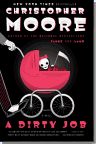
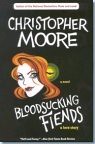
Major fan-girl here for absurdist fiction author Christopher Moore. A Dirty Job is my favorite, even though it's tough to convince somebody that hilarity ensues after a man's wife dies in childbirth. Next in my love-fest with the author are Bloodsucking Fiends, which was my introduction to Moore - thanks Mary! - and Lamb: The Gospel According to Biff, Christ's Childhood Pal, followed by You Suck and Fluke: I Know Why the Winged Whale Sings. Although for my friend Gail last year's Fool supplanted A Dirty Job, I feel as though I need to re-read King Lear to do it justice, and simply haven't had the time. I do plan to read the brand-spanking-new Bite Me, though - which follows Bloodsucking Fiends and You Suck in a series - as soon as possible. While the second book wasn't as fantabulous as the first, the excerpt for the third looks hilarious.
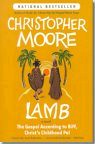
Lamb, btw, is the perfect book for any friend with a great sense of humor, whether or not they read a lot of fiction. I suggested it for my husband, who reads a lot of dry crap for his law practice and so doesn't do a lot of recreational reading, and now he's convinced "this guy writes like me."
Anyway, before I digress further...Christopher Moore wrote a short piece for the Huffington Post a couple of weeks ago. If you blinked, you probably missed OMFG, Horatio, in which he writes about language. If you like Moore, surely one of the reasons you do is that he's a master wordsmith, something I got into when I interviewed him a few years ago. I hope he writes more for HuffPo in the future; OMFG is a good start.


Share/Bookmark

March 22, 2010

Books To Look For

I've been very vocal about my love for Gail Carriger's Soulless, my only Publishers Weekly starred review for 2009. And I've hand-sold quite hard Lori Handeland's Phoenix Chronicles. At the bookstore I hand-sold about 50 copies to date of the former - and because of that sales record the store will be sent roughly the same number of copies of the sequel, Changeless. As for Handeland's series, I've sold roughly 3 1/2 dozen of book one, somewhat less of book two, and less still of book three.

Part of the problem is that with an urban fantasy series, you can't sell books two or three without selling book one. Because we haven't had many copies of each book at one time, I can't often do what I managed to do during my last two shifts: sell all three together. Most readers new to the series, though, take a slower approach and simply buy book one. When they come back, we don't have books two or three, and they end up ordering copies online, or they go elsewhere. It's tough because the series is very much a sleeper; I can only hope it catches on, and with Keri Arthur's Riley Jenson series coming to an end in June, there will be one less series with which it must compete.

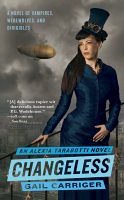
Last week I read Changeless, which is terrifically funny, very visually Steampunkish, and, like Soulless before it, pitch perfect. The cliffhanger ending is its only flaw, but I'm sure all will be resolved in book three (Blameless), to be published at the end of summer. But back to Changeless...there's a moment during which a rather clueless character remarks about the love between "Pyramid and Thirsty" that so reminded me of A Midsummer Night's Dream that I marveled at Carriger's skill. (My daughter has so far been the only one to "get" the reference, which surprised me as those I asked were literate folk.)

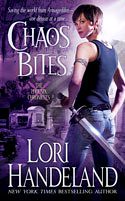
I've not yet read Chaos Bites, although I did read the excerpt Handeland has up on her site. As expected, it was exciting, intriguing, and sexy, and I look forward to reading it as soon as it goes on sale. Because it's such a sleeper series, though, I worry about its long-term success and whether or not the author will be given the opportunity to take it where she wants it to go. At the author's website, just one title (Demons at the Gate) is listed beyond Chaos Bites...I hope the series won't end there.

So here are covers of both books, with links to the author's sites, as well as some of the other books I'm looking forward to in the near future:


What are you looking forward to reading...and if you read urban fantasy, can I convince you to try The Phoenix Chronicles?


Share/Bookmark