Showing posts with label non-fiction. Show all posts

September 14, 2011

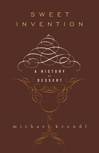
Sweet Invention

Michael Krondl

Non-Fiction

Grade: B-

Michael Krondl’s Sweet Invention: A History of Dessert, takes readers on an often fascinating journey of desserts in six “dessert superpower” regions: India, the Middle East, Italy, France, Austria, and the United States. The history of food...even of the icing on the cake as opposed to the cake itself...is as terrific a way to impart knowledge as is the history of fashion. Both are surprisingly good as they give us an accessible way to track changes over time in arenas as diverse as politics, economics, religion, transportation and other technological advances, gender issues, the culture as a whole, and how societies are organized over time.

Though copiously researched, Krondl doesn’t give each of the six “superpowers” equal time, which may satisfy historians more than the casual student of history or foodie. I learned a great many tidbits about India in particular, and I’m glad now to know that they love their sweets; that because there are so many gods/goddesses and avatars, there are lots and lots of sweet-filled holidays; that sweets are more associated with boys than girls; that the lack of Western-type ovens results in lots and lots of fried sweets and none that are baked; and that the circumcision of boys does not occur at birth but rather between the ages of seven and twelve. But I wish more word count had been devoted to the particular history I crave: European and “American.” I realize this says as much about my character deficiencies as it does the book’s, but the history I did learn about the intersection of dessert and culture, gender, economics, politics, and people in Europe and the U.S. was so fascinating I simply craved more.

For instance, I already knew the American preference for milk chocolate as opposed to the French preference for darker, less sweet chocolate, but I didn’t know how Milton Hershey’s deprived childhood played into it. Or that population density...or lack thereof...along with changes in technology, the move from feudal, rural, and aristocratic cultures to urban living and the eventual growth of the middle class tied into when we ate, who prepared our savories and sweets, and for whom they were prepared. Krondl creates linkages out of changes in social economic status, democracy, even the Baby Boom, and his thought-provoking connections deserve study.

It seems obvious that if the mode of dress for an adult male is the same as it is for a 12-year-old boy (jeans, t-shirt, baseball cap), that his palette will differ from an adult male who requires a valet to dress and groom himself. It seems equally obvious that when a culture is focused on maintaining a power structure or Keeping Up with the Rothchilds, different attitudes toward food will develop in comparison to cultures simply sustaining themselves on the frontier...or those with a focus on individuality, portability, and ease of creation. These things seem obvious but only after you begin to actually consider them.

What worked less for me were all the desserts that frankly sounded quite the same to me. Yes, the actual history of the Sacher and Linzer Tortes intrigued me; I was less fascinated with the myriad descriptions of this or that fried sweet. Sometimes a donut, after all, is just a donut. Why not, instead of only focusing on how sugar is refined and how pricing affected dessert, also delve into the varieties of caramel, who invented the creme brûlée, or indeed thought to brûlée sugar?

My only other criticism is that I felt the author gave short shrift to some of the more modern history of dessert, although his insight that today’s restaurant pastry chefs are more innovative than are those at bakeries and pâtisseries was spot on. Sweet Invention wasn’t a perfect recipe for the history of dessert, but it provides ample food for thought.


Share/Bookmark

August 3, 2011

The Philosopher and the Wolf by Mark Rowlands

The Philosopher and the Wolf

Mark Rowlands

Grade: B

Non-Fiction

The eleven years philosophy professor Mark Rowlands spent with Brenin the wolf at his side profoundly impacted his life. He came to see himself less as an owner or guardian to the animal than as his brother—generally older, but sometimes younger, depending on the lesson learned, and which of them learned it.

The author immediately learned, for instance, that he could not leave Brenin alone or within moments the wolf would make his displeasure known in severley destructive ways. An adjunct to that lesson: If you keep a wolf, you must add $50k onto the price of your home, to cover the damage. Lesson number two? Well, as a result of lesson number one, Brenin accompanied the professor to class. Over time that required him to adjust the class syllabus with a warning that unless students kept foodstuffs in their backpacks thoroughly locked up, they could expect a visit from a foraging wolf. A third lesson: Brenin’s natural, ahem, exuberence could only be overcome by fatigue, so Rowlands learned to tire him out each day through long, long runs. And a fourth: It’s possible to teach a wolf to heel, but you must out-alpha a wolf, and vigilantly maintain that stance throughout the relationship.

The most important lesson learned, though, was one Brenin taught Rowlands while still a pup. It’s predicated on the author’s thesis that as a result of evolution, the worldview of man is simian in origin. As such we rely on social intelligence, so that our subsequent civilization is built upon scheming, plotting, and lying. That's a condensed, bald description, but I think it's an accurate one. After all, in the review of the book by O, the Oprah Magazine, Rowlands is referred to as misanthropic. Which, frankly, is what drew me into requesting the book from @NetGalley for review.

Rowlands proves his point, at least to a degree. Think about it: We are here as a result of natural selection...survival of the fittest. Our ancestors didn’t stand in line for this or that—they made sure they went to the head of the line, or were the ones to create the line. They weren’t the nice ones or the meek, and the author describes in detail how a congregation of apes maintain their cohesion—through intimidation, side-deals, lying, and covering up—all of which makes his point rather nicely. His discussion of sex in the simian world versus the canine and lupine world fascinated me, and helped prove his point as well.

If apes rely on social intelligence, wolves rely on mechanical intelligence, and in ways that didn’t entirely carry through the process of domestication to dogs—did you know a wolf will learn how to open a door more quickly than a dog? Wolves are big on mechanical thinking while dogs accept a more magical form of thought, which he describes in a funny vingette about telephones.

There’s no subterfuge or grudge-holding in the wolf world; I kind of imagine, in reverse anthropomorphous, that Denis Leary would be a wolf. You see what you get, without any bullshit or sugar-coating.

When Brenin was around two months old...Rugger [a pit bull] lost his temper, grabbed Brenin by the neck and pinned him to the ground. Most puppies would have screeched out in shock and fear. Brenin growled. This was not the growl of a puppy, but a deep and calmn and sonorous growl that belied his tender age. That is strength. And that is what I have always tried to carry around with me, and I hope I always will. as an ape, I will fall short of this; but I have an obligation, a moral obligation, never to forget it and to emulate it as far as I can.If I can only be as strong as a two-month-old wolf cub, then I am a soil where moral evil will not grow.

An ape would have scurried away to darkly plot his revenge; to work out ways of manufacturing weakness in those who are stronger than him and who have humiliated him. And when that work is complete, then evil can be done. I am an ape through accident of birth. But in my best moments I am a wolf cub snarling out my defiance as a pit bull has smashed me into the ground. My growl is a recognition that pain is coming, for pain is the nature of life. It is the recognition that I am nothing more than a cub and, at any time, the pit bull of life can snap my neck like a twig. But it is also the will that I won’t back down, no matter what.

When the shit hits the fan, you will believe. When the shit hits the fan, people look for God. When the shit hits the fan, I remember a little wolf cub.

The Philosopher and the Wolf is filled with wonderful vingettes of Rowlands’ years with Brenin, interspersed with various philosophies, among them Sartre and Nietzche, to explain or justify various aspects of taking a wild animal and domesticating him. I’m not entirely sure his justification is 100% solid, but there’s no way I’m taking on a philosopher, who could talk a ring around me and lock me in within five minutes. In the end I'm satisfied Brenin's life was a happy one.

The book comes alive during those remembrances of Brenin, and occasionally falters when the philosophical or scientific sections seem to prattle on. It’s worth the prattling, because at the end the author does reach his point.

I love wolves and the idea of wolves, but this book is not solely for the wolf-obsessed. For the most part it's well-written, although the author's prose during the preface tended toward the purple. But as soon as Chapter One begins, with his bookending of Brenin's death and their first meeting and first hours together, I realized I was crying and laughing almost simultaneously. The lessons Rowlands imparts engross the reader because as all good teachers do, he provides vivid examples to accompany them. Because in the end what leaves the biggest impression for those who cherish animals, whether wild or domesticated, is the impact Brenin left on his brother.


Share/Bookmark

October 19, 2010

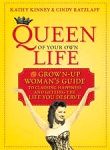
Queen of Your Own Life by Kathy Kinney and Cindy Ratzlaff

Queen of Your Own Life

Kathy Kinney and Cindy Ratzlaff

Grade: C

Non-Fiction

Queen of Your Own Life would have been a five-star magazine article, but there's not enough content to justify a full book. Kathy Kinney, who portrayed horny librarian Miss Goddard on Newhart and Mimi on The Drew Carey Show to perfection, co-wrote the book with her long-time friend Cindy Ratzlaff, who created the marketing plans for more than a hundred NYTimes bestsellers. The book features "the seven bet gifts a woman can give herself": 1)Claim your beauty and feel your power; 2) Clean your mental closet and find your queen voice; 3) Admire yourself for who you've become; 4) Build deep, fulfilling frienships with other women; 5) Establish firm boundaries that will strengthen all your relationships; 6) Learn the simple trick to finally being happy; and 7) Proclaim yourself queen of your own life.

Read this Amazon Vine review in its entirety at Amazon.


Share/Bookmark

May 22, 2010

War by Sebastian Junger

War

Sebastian Junger

Grade: B+

War Memoir

Many years ago on my old blog I wrote about having a crush, in this instance, a nerd-crush, on the journalist Sebastian Junger. Junger and Fareed Zakaria are both journalists I keep tabs on. I watch Zakaria's Sunday CNN show without fail, and when War became available on my Kindle, I downloaded and read it. I just posted a review of it to Amazon and here's how it begins:

Sebastian Junger's reporting on Afghanastan pre-dates September 11th; he profiled Northern Alliance leader Ahmad Massoud for National Geographic in March 2001. Massoud, you may recall, was assassinated by al-Qaeda just two days prior to their attack on the U.S. Junger is best known for The Perfect Storm, but for years has reported from other hotspots like Sierra Leone, Liberia, and Kosovo, often in advance of their becoming known to the wider public. For War, Junger embedded five times over a period of fourteen months with a platoon in the 2nd Battalion in the Korengal valley, Afghanistan, describing events not from a geopolitical perspective, but from that as a front-line soldier in a war most of us pay little heed. For me his book succeeds where Marcus Luttrell's Lone Survivor did not. While Luttrell's book begins brilliantly, his politics soon take over. Junger is more interested in what drives young men to fight, how they survive - not as individuals but as a unit - on a day-to-day basis in danger, isolation, and primitive conditions, and describes the nearly sexual thrill of combat...

Click here to read the rest of my review for Amazon


Share/Bookmark

May 2, 2010

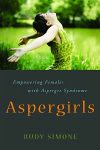
Aspergirls by Rudy Simone

Aspergirls

Rudy Simone

Grade: C

Non-Fiction/Self-Help

Amazon Vine just posted my review of this book, which begins...

The symptoms of Asperger's are different in girls than in boys and most of the studies on the Syndrome have focused on boys. Doctors and other mental health care professionals simply don't know what to look for in girls and as a result, the number of undiagnosed girls is unknown but likely quite large. Rudy Simone's book, then, which focuses entirely on girls and women with AS, is like a breath of fresh air. Aspergirls gives girls and woman a way to positively own AS because, after all, it is what it is. But I found a line on the back cover blurb to be misleading: "If you...think you might be on the spectrum, this book will be essential reading."...

Click here to read the rest of my review for Amazon


Share/Bookmark